Checking it out. What is actually there?
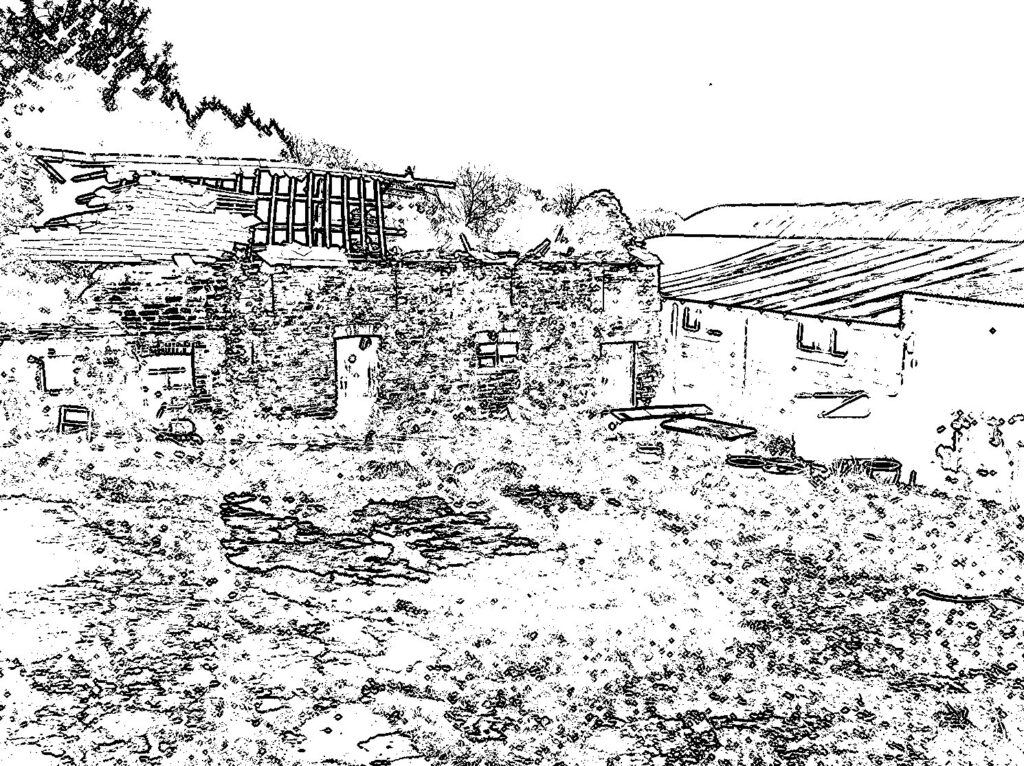
Practice doing searches online, and then go visiting sites just to get used to how to travel around the countryside easily.
A word of caution.
What can appear completely abandoned can still be a live site. I’ve found this out the hard way on numerous occasions, sometimes being amazed that someone is still living in what looks like, and often is a completely derelict property. You just never know. You can only find this out when you get there. You will probably be trespassing, so exercise caution when actually entering any location, and if there is clear evidence of a property being lived in, withdraw immediately.
What you may need to bring with you in order to get access. I don’t mean hammers and a crowbar(you can get arrested for that). You may need to clear some very nasty foliage just to get near a property. Be prepared for this. Carry a small strip of scrap carpet so you can climb over barbed wire. Believe it or not, the mere bramble will be your biggest enemy. They can make somewhere completely impossible to approach, so strong gloves and secateurs will be needed.
Dress in your worst clothing and decent boots. When places become abandoned, they can become health and safety nightmares. There may be all sorts of hazards, and ground can be waterlogged and flooded. Be prepared.
How do you intend to record the location, photo’s, maps, printed drawings. Any kind of record you keep at this stage is good evidence that can be used for a future claim. I have acquired a type of camera which is waterproof and virtually indestructible, and surprisingly cheap. I’d rather have something I can afford to drop rather than an expensive cellphone.
Unless you are very specific about a particular property, plan to visit a few in a day, or even just do a walk past to get the lay of the land.
If you travel 100 miles to look at an apparently abandoned place only to find it’s a hive of activity, it’s worth having a plan B, or C. Most of the satelite imagary you’ll have been studying can be years old. Things can change a lot, often in a short period. Be prepared to be dissapointed, at least some of the time.
Visiting an actual target property.
Unless you’re in the middle of nowhere, be cautious of taking the very direct approach. Neighbours may well be on the lookout, particularly if a property has been found, used for dumping, gypsy caravans, drunken parties etc.
Most properties have a variety of boundaries. If you plan to get in, use a side opening, somewhere where any activity won’t be noticed.
And most people probably wouldn’t be aware of this, but even the slightest change can actually be very noticeable to other people who are very familiar with exactly how something does look over time. We are very good at spotting when something has been moved or disturbed in any way.
When you’re going around the site, keep disturbance to a minimum, don’t interfere with anything you don’t have to, and above all, keep the noise down.
In the country where there is a general absence of noise, a phone going off, or people talking can carry for miles. Practise the art of moving as silently as possible. You won’t be perfect, but what you will do is become very tuned to all the noises around you, especially your own.
Look at the access on the maps before you get there. You may want to take a slightly tortuous route to the property just to avoid passing the neighbouring property which is very active.
I’ve done this lots of times. Be aware of where you can be visible from. I will climb fences and cross a field to avoid being seen from a farm, or house. And properties in the country are often a lot more active than you would think. Just don’t take the risk, not in the early stages.
Oh, and don’t take Fido for a walk on this one unless you’re doing a walk by on a public footpath. Even if you’re quiet, a dog can trigger other dogs in the area. They are very sensitive to other dogs crossing their territory. And if you’re climbing over fences and gates, how will a dog do that? Is it worth it.
Don’t make it obvious the property is being visited. If locals are on high alert, they will notice any changes, and this will just make them more vigilant. You have no idea of the history of a site, and how people will react if you turn up. They may welcome you as a hero, but they probably won’t.
Your approach will probably depend on your overall plan.
Be very wary of alerting neighbours
One property I actually own, bought legitimately at auction is a stretch of disused railway line(¾ mile long!!). It was sold 100 miles from its location, and the neighbours had no idea it was even for sale. The sale particulars suggested it was a couple of miles away. It was only by matching the land registry map to OS maps that I got the actual location.
When I spoke to the neighbours later, they told me that they would have been interested in buying it as it would be perfect to access other bits of land etc. Their pockets are a lot deeper than mine. I wouldn’t have stood a chance had they been there on the day.
You have no idea what potential interest a neighbour may have, and they’re not very likely to share their plans with you. Where possible gather information as anonymously as possible.
You will have no idea what interest anyone else has in a property. There is a danger that you showing an interest in a property will trigger someone else into taking action. There are few things that will prompt a reaction than the thought that someone else is planning to get something that you believe you’re entitled to, or which you can simply grab for yourself.
And if you’re in the country, you’re likely to be surrounded by people who have access to some serious equipment, will have tools, fencing equipment, and the knowledge and skill how to use these as a matter of course. For them to extend themselves onto a nearby piece of property would be straightforward. A neighbour may have been quietly thinking about doing something on that piece of abandoned land for years. The mere thought that someone else can come along and scoop it up in front of you will inevitably provoke some kind of reaction.
And always bear in mind the fundamental, and what should always be the first principle. Whoever is in factual possession of any land will always have the greatest, and most defend-able claim upon it. Aim the be there first, always!!
Be cautious going into any derelict property, sheds, caravans, vehicles etc. You have no idea what kind of deterioration has hapenned over time. Floors can be collapsing, stairs rotten, trip hazards everywhere.
Sometimes, just getting into somewhere that appears to be open can involve gymnastics, so being quite fit and flexible is an advantage. I’ve gone through numerous open windows where I then have to negotiate furniture piled up, and often stuff..lots of stuff.
Places that have been abandoned will often get stripped quite quickly of anything that appears to have any value.
This may help you as doors and windows will already have been broken, but sadly people who nick stuff are rarely tidy. Anything in their way just gets dumped and left. This is now your obstacle course so beware.
Another concern, particularly close to towns and cities is that abandoned property can become useful to alcoholics, drug users, kids, and pretty much anyone, so all kinds of paraphernalia can be left lying around. Dirty needles, broken glass. Again that class of people who rarely clean up.
And there is of course the danger you could disturb someone else going about whatever business they’re engaged in. They probably won’t like you being there so again exercise caution.
Farms and industrial sites will have bits of machinery and other stuff. Farms are especially dangerous as these things can become overgrown, and almost hidden from view. Trip hazards galore.
The most dangerous though is that humble bramble. When they’re up high, they’re easily seen, cut out the way, or stepped over. Laying close to the ground, they end up growing and therefore strongly tethered at both ends, thus forming the perfect invisible trip wire. I’ve gone flying numerous times, and almost always into another patch of brambles, or their close ally, the stinging nettle.
Always aim to get out in one piece.
And stating the obvious, if you’re exploring where you probably shouldn’t, does anyone know you’re actually there. What happens if you do come a cropper, and find yourself hurt, or stuck. Who would know. Leave some kind of record where you’re going.
You think I’m being over cautious. There have been numerous occasions where I’ve come a cropper and seriously frightened myself with the potential implications of what I’ve done.
I’ve fallen through rotten floors, tripped over stuff, fallen getting over rotten fences, and any number of variations on the same. I’m quite agile and flexible, so have never done any real damage, but it wouldn’t be hard.
And it should be obvious, but take your time. These places have been like this, probably for a very long time. You don’t need to be in any great rush.
For the most part, once you’re actually on a derelict site, you’ll be almost invisible. The way these sites disappear is what can also hide you. If you hear activity close by, just wait till it passes.
I have visited literally thousands of sites, and apart from a couple of slightly embarasing encounters, I have never actually been caught on a site, challenged, threatened with the police etc. There have been numerous times where I have ducked behind a hedge, dropped to the ground, hidden behind a building, and in some cases, staying there for 20 minutes while someone potters around.
And as for when to visit. Most of the time you can just land whenever you want, particularly if you can legitimately be at or near a location. If there are footpaths, use these, and no one can challenge you.
I will often walk across fields, but do tend to be aware of any activity anywhere around.
If a site is potentially live, anytime after dark will reveal lights on.
For some locations where there is a very high risk of being seen, just pick a full moon, when you can literally walk around most of the night in brilliant moonlight. You won’t even need a torch.
You will almost always see general signs of activity as you get closer to a location. Anywhere with a lane will show signs of activity and use, driveways will have moss disturbed etc. The more evidence of use there is, the more cautious you will need to be.
But be wary of being put off by such signs. A lane through a farm may show signs of use because access is needed to other fields etc. You can always tell if it’s domestic or farm use by the nature of the actual tracks. You will probably have worked a lot of this out by studying the satellite photo’s which reveal the type of use you can expect.
But abandoned sites can also have power still connected, timers lit up on the cooker etc. I’ve been to places where you hear the regular chirp of a smoke detector as the battery is nearly worn out. These things can go on for years.(if people die, bank accounts can still pay utilities for years unless these things are sorted out. Sometimes it appears, they’re not)
These things are disconcerting, but not necessarily evidence of recent use. I some cases, check places repeatedly over time, or set cameras to see if there is actual activity at the site, and you just don’t see it on a single visit.
This is also why you never make it obvious you’ve been there. You never know how others will respond to activity on a seemingly abandoned site. Go in quietly, leave having disturbed nothing.
In one example. I visited a house that had not seen use for decades. Imagine my surprise when, looking through the window, I saw the image of me, captured on some concealed CCTV, and being shown on a permanently on TV screen on the wall opposite. I withdrew. In another, having climbed over mounds of junk to get in, I found a very live phone answering machine blinking away. I can be amazed at what you can find.